












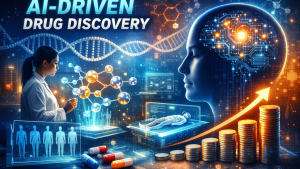
For decades, drug discovery was a game of “search and find.” Scientists would screen libraries of existing compounds, hoping to stumble upon a “hit.” Today, we have entered the AI-First era, characterized by a fundamental flip in logic: we no longer search for molecules; we generate them.
1. From Predictive to Generative: The Core Shift
In the previous “Models” era (roughly 2010–2020), AI was used primarily as a filter. We had a library of 10 million molecules, and we used machine learning to predict which ones might work.
In the “Molecules Over Models” era, we treat chemistry like a language. Using Generative Adversarial Networks (GANs) and Diffusion Models (the same tech behind AI art), researchers can now input a target—say, a specific protein pocket in a cancer cell—and the AI designs a brand-new molecule from scratch (de novo) that fits that pocket perfectly. The focus has shifted from the tool (the model) to the output (the specific, optimized molecule).
2. Solving the “Eroom’s Law” Problem
In pharma, there is a depressing trend called Eroom’s Law (Moore’s Law spelled backward). It observes that drug discovery is becoming slower and more expensive over time, despite better technology.
AI-first discovery breaks this by:
- Shrinking Timelines: What used to take 5 years (Target-to-Hit) now takes months.
- Reducing “Wet Lab” Waste: Instead of testing 10,000 physical compounds, scientists use “Digital Twins” to narrow it down to the 10 most promising candidates before ever touching a pipette.
3. The Three Pillars of the New Era
I. High-Fidelity Data (The Fuel)
A model is only as good as its data. Companies like Insilico Medicine and Recursion Pharmaceuticals are building massive automated “dry-to-wet” loops. Robotic labs run thousands of experiments 24/7, feeding the results back into the AI to refine its understanding of biology.
II. Multi-Objective Optimization
In the old days, you might find a molecule that kills a virus but accidentally destroys the liver. AI-first platforms perform Multi-Objective Optimization. They design for potency, solubility, and safety simultaneously, ensuring the molecule is “drug-like” from day one.
III. Protein Folding & Structure
The breakthrough of AlphaFold changed everything. Knowing the 3D shape of every protein in the human body allows AI to design molecules that act like precision keys for very specific biological locks.
4. Real-World Wins
We are no longer talking about “potential.” We have results:
- ISM001-055: The first AI-discovered drug for Idiopathic Pulmonary Fibrosis reached Phase II clinical trials in record time.
- Halicin: An AI-discovered antibiotic capable of killing drug-resistant bacteria that had stumped human researchers for years.
5. The “Molecules Over Models” Philosophy
The title of this era implies a healthy skepticism of “black box” AI. The goal isn’t just to have a fancy algorithm; the goal is the physical asset.
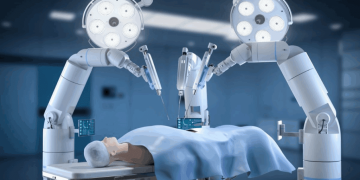
The industry is moving toward Autonomous Labs. We are reaching a point where the AI doesn’t just suggest a molecule; it sends the instructions to a robotic synthesizer, creates the molecule, tests it on a “chip” (organ-on-a-chip), and updates its own code based on the failure or success.
6. The Challenges Ahead
Despite the hype, biology is messy.
- The “Black Box” Problem: AI can tell us that a molecule works, but it doesn’t always tell us why.
- Clinical Success: Designing a molecule is only half the battle. It still has to survive the rigors of human clinical trials, where biology often proves more complex than any simulation.
The Bottom Line
The “Molecules Over Models” era represents the industrialization of ingenuity. By treating atoms as bits, we are turning the accidental “discovery” of medicine into a predictable “engineering” discipline.
Would you like to zoom in on a specific part of this process, such as how robotic labs work or the current FDA status of AI-designed drugs?









Discussion about this post