











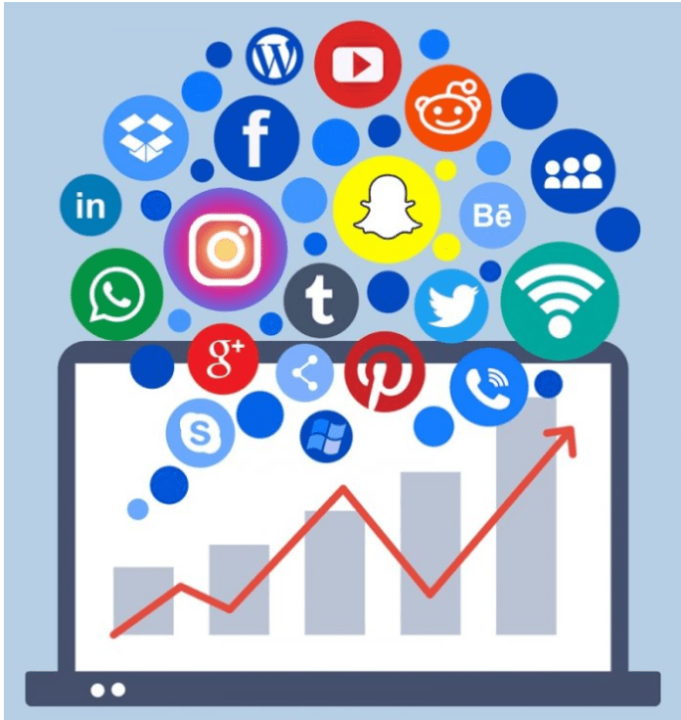
Information exchanged over social media needs monitoring, with potent mechanism, for quality, reliability and user’s confidentiality and privacy. There are large numbers of social media, which might create dilemma that, which media will be the vehicle to reach the targets. On the other hand, many users, including health institutions and professionals use more than one social media, which are often interlinked with one another, enabling one-point multiplatform sharing. However, the relative effectiveness of the different types of social media for health communication and social media based different intervention models should be determined using randomized control trial. Research in the field of social media and health are still in infancy and in case of Nepal it seems to be in the prenatal stage.
Very modest evidence that interventions incorporating online social networks may be effective, with the problem of retention of health information and sustainability of behavior change. Hence, research in this field should be in priority of the scientific community and public health establishment in Nepal, for which Nepal Health Research Council (NHRC) should play the leading role. In the context of Nepal, the public health establishment, particularly governmental health organizations, seems skeptical towards this landscape, which is evolving at a blistering pace or are unclear about how it could be used. Authenticity of online health information poses another question towards the roles of health service providers to mitigate concern about misinformation without breaking user’s trust, as there is greater risk of fabrication. Integrated national e-strategy development and implementation as aimed in broadband policy 2014 should incorporate comprehensive public health communication strategy to address these issues. Furthermore, digital divide among elderly, minority and poor population is social injustice, which may bring disparity in health information access. Nepal still ranked 136th with ICT development index of 2.59 (19). Hence, the Ministry of Health and the Ministry of Information and Communication should work in collaboration to reduce the digital divide, address social media security paradox, create opportunities and utilize them for the promotion of better health
In a study, 53 percent of government officials in Nepal spent three or more hours per day on social media. Though 89 percent of them believe social media to have positive impact, it brings some serious health problems directly or indirectly (14). According to Pew Research Centre, four in ten internet users in US experience online harassment (15). Data related to Nepal is lacking, though a study done among school students in Kathmandu valley points out 66% experienced at least one form of cyber bullying, while 34% received hateful messages (16). Cyber victims and cyberbullies face more emotional and psychosomatic problems, which further leads to social difficulties and feeling of being unsafe. Cyberbullying is often associated with severe depressive symptoms, ideation and substance use and even suicide attempts (17). These problems lead to poor psychosocial health and reduce productivity of the individual. Further, there are other offline consequences of online victimization. On the long run, it changes the concept of friendship and can affect culture, a determinant of health. Reduction in face-to-face communication due to increased use of social media, affects social relationships in daily life. Social media not only affects social dimension of health, but also largely interact with other dimensions like physical and mental.The possible physical manifestation in the long term are obesity and diabetes influenced by the slowdown of metabolism and sedentary lifestyle associated with increased social media use. Further, big demons of the over use of social media are depression, mania, anxiety, sleep deprivation, eating disorder and internet addiction (probably epidemic of this century), insecurity and FEMO (Fear of Missing Out), and a degree of anti-social behaviors. They are growing silently in Nepal too, which is evidenced in fragmented researches done in different pockets so far in the country. A study shows, greater distractions and low grade among strict Facebook users among students (18). Vulnerable or troubled teenagers are at greater risks of those effects. Moreover, with possibility of wrong health information pandemics, it can mislead certain groups of people in Nepal, especially whose health literacy is not good enough. Along with it, there is threat of catchy Ads, which can be detrimental to health sometimes as they can influence health habits and health choices
for Detalis
https://www.nepjol.info/index.php/HPROSPECT/article/view/17099/13903









Discussion about this post